
Introduction
Creating content through marketing becomes very hard when there are no processes in place. Almost all organizations have challenges concerning inconsistent content production, improper thinking structure, delayed schedules, and inconsistency in content with organizational goals.
This is when the role of AI-driven content development and a properly organized AI Content Calendar becomes useful. Instead of using traditional methods, businesses can opt to use AI-based software to optimize their content generation process.
But no matter how helpful AI may be, it has to complement content development, not replace it. The following is a guide on creating an AI-powered Content Calendar from Scratch. Organizations that succeed in Building an AI-Assisted Content Calendar always integrate technology and creativity with an effective marketing strategy to flourish.
Build the Foundation of Your AI Content Strategy
The most significant error that businesses undertake utilizing AI content generation tools is creating initial/input tasks without having already developed a strategy for achieving their desired outcome(s) through the content produced; otherwise, the resultant output (i.e. content) will literally just be a bunch of unconnected ideas ultimately never contributing towards the desired level of business growth.
An effective Content Calendar should begin with defining your organization’s respective objective(s) relative to producing the type(s) of content you will ultimately generate for business growth purposes.
Are you seeking to: Increase your overall organic traffic? Provide leads qualified for your sales team? Establish your brand as an industry expert? Educate your customers on specific products/services? Provide additional resources to encourage more users utilizing your product(s)? Increase your engagement on social media platforms?
The answers to the questions above are what will produce the information / direction for the content calendar.
A SaaS company focused on creating qualified leads will create distinctly different content than an agency focused on building its reputation via thought leadership; and eCommerce marketers creating seasonal buying guides will produce different types of written/visual content than B2B companies creating long-form educational articles for their buyer personas.
After defining the overall objective(s), you can then define how your organization is able to produce the content you will generate towards achieving your operational and strategic business goals.
Content pillars are the foundational buckets that your content strategy revolves around. They allow you to think systematically about your content and avoid chaos on your calendar.
Let’s say that you own a digital marketing agency – the pillars that you use could be SEO, content marketing, AI workflows, social media strategy, GEO search, and paid ads.
You can then create different subtopics under each of those pillars.
This is very important because AI does work very well with direction. The more structured your input is, the better your output will be.
If you don’t have content pillars, then it becomes very difficult to stay consistent with your content creation. Content pillars turn your AI-Assisted Content Calendar into an actual publishing system.
Use AI to Plan and Organize Content More Efficiently
Without a framework to enable content marketing, it can be difficult. The main challenges faced by businesses include irregular scheduling, disorganized thinking, delayed content creation, and content not aligned with business objectives. In such cases, AI-driven content planning tools can help significantly in enabling businesses to become more successful.
Thanks to AI-based software, you will be able to work with topics, workflows, and scheduling. Despite that AI should be applied together with human approaches, AI-based solutions will definitely help you have a highly efficient content calendar.
Firstly, formulate your content marketing objectives, like increased website traffic, lead acquisition, or awareness. Secondly, come up with content pillars based on the set goals, which will classify your content according to your brand’s topics. This way, you will develop unique brand identity through your content classification.
It is going to help with such tasks as content ideation, keyword research, categorization of search intent, GEO search, and even outline development. Also, it will contribute to process optimization with the aid of content writing, re-writing, and planning.
Bear in mind that too much automation can have adverse repercussions on the quality of AI-generated content. This type of content often causes distrust among users and devalues the unique brand voice. In other words, AI cannot do content generation independently; a human touch is necessary.
The goal when making a Content Calendar from Scratch using artificial intelligence is to find the right ratio of technology and strategy. What you need to aim for is developing a system capable of constantly generating high-quality content.
Create a Scalable AI-Assisted Publishing Workflow: Step-by-Step Guide
Content marketing initiatives sometimes flop, not due to bad content marketing ideas, but due to a lack of workflow that enables successful execution. Deadlines are missed, departments operate in silos, and publishing becomes sporadic. Developing an organized and efficient AI-powered workflow will enable overcoming such challenges.
Step One: Get New Idea for your Next Marketing Campaign using AI
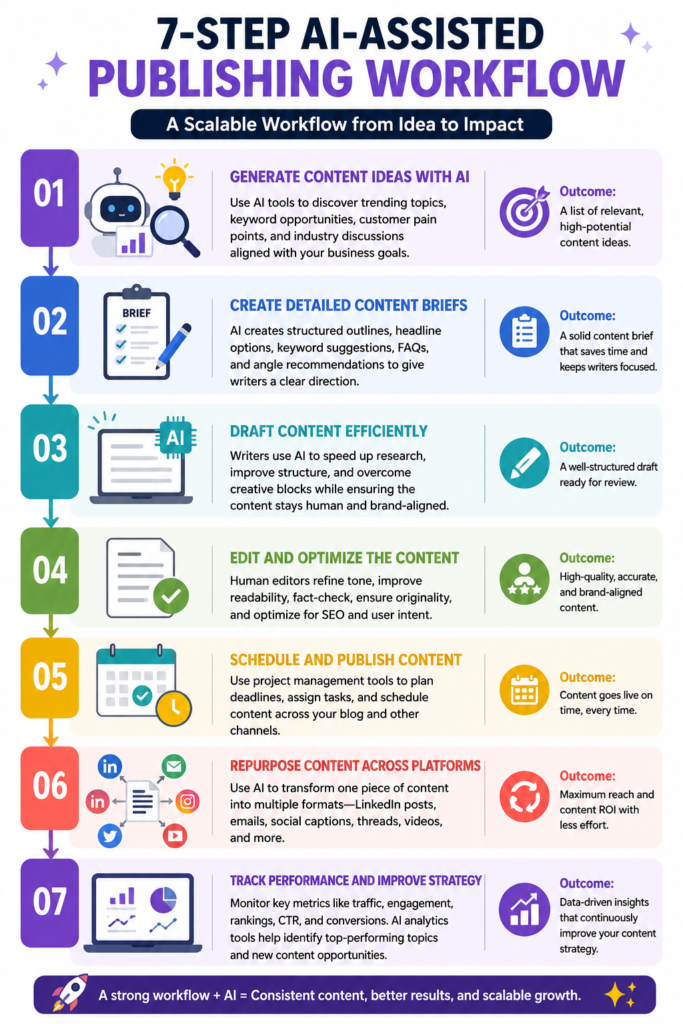
Coming up with fresh ideas can often be one of the most challenging things when it comes to developing new ideas for your marketing campaign. Companies can use AI to make this whole process easy for them since they are able to generate great ideas based on the issues that their target customers face; instead of having to brainstorm ideas for several hours, the companies get ideas based on data gathered using the tech that they have and through GEO searches.
Step Two: Creating content briefings
After settling on the topic that you wish to address in your content, the next step will be creating content briefs. You’ll be using AI to create your outlines and heading. Besides this, you can get lists of keywords and angles that the writers should use in writing their content.
Step 3: Write Content Seamlessly
The writers can now use AI to conduct research and help them write more seamlessly, without facing any obstacles. At the same time, the content must not appear machine-made; it must seem organic and insightful.
Step 4: Edit & Optimize the Content
Content editing is a very critical step within the entire workflow. The role of human editors in this stage is to edit the content for tone, readability, fact-checking, and ensuring that the article is original. In fact, AI articles will need to go through human editing.
Step 5: Schedule & Publish Content
Once content has been approved, it’s time to move on to the next stage — publishing it. You can do this using any of the following software; Notion, Trello, Clickup and/or Airtable.
Step 6: Repurpose Your Content
The real power of artificial intelligence technology comes through the capability of repurposing your content. The same blog post can easily be transformed into LinkedIn updates, emails, videos, and more. Artificial intelligence will help you to maximize your ROI on content without having to create anything new all the time.
Step 7: Measure Performance and Improve Your Strategy
The final aspect that needs to be included in every content marketing process is measurement. This consists of looking at factors like traffic, engagement, keywords performance, click-throughs, and conversions. Using tools powered by artificial intelligence will tell you what topics perform best and guide you towards creating the perfect AI Content Calendar.
Don’t Allow the Role of AI to Extend Throughout the Process
The speed of content creation can be increased by the use of AI, but when too much emphasis is placed on it (over-reliance), it does lead to an increase in generic and repetitive content creation. Many companies who begin to use AI for content marketing have a tendency to place more value on quantity than they do on quality, as AI allows for them to produce content quickly. Often, though, AI will not produce long-term credibility.
Moreover, using AI without adequate editing could also lead to loss of the brand’s unique voice. When automation becomes part of the work process, many businesses develop unrealistic publishing plans. While an aggressive publishing frequency may seem like a good idea, consistency is more important than volume when developing sustainable content plans.
AI must support the creation of content, not eliminate human contribution. Elements such as creating the strategy behind the content, telling a story through the content, being original/creative with your content, and connecting with the audience that will consume the content require human intervention. The most successful outcomes will be achieved when the combination of the efficiency of AI and the creative direction and editorial oversight provided by a person is used to successfully Build an AI-Assisted Content Calendar.
Conclusion
AI-aided content calendars do not attempt to replace the human creative process. They serve rather as a means of developing a better content organization process.
In an optimal scenario, the use of technology allows for streamlining the content process, making it more consistent and faster, but human insight is still needed in matters of strategy and storytelling. Those who are successful in their content marketing using AI technology do so by combining efficiency with editorial control, structured Content Calendar planning, and smarter GEO search strategies.


