
Technical audits are an important component of keeping a successful site healthy, however they typically take a lot of time to complete. The site grows; as such, the more complicated it is to do a proper site audit (with new pages created, data added, and errors).
Believe it or not but it is true that what may start off as a quick 5-minute Technical SEO audit can end up taking you several hours. You might need to go through crawl reports, spreadsheets, or any other resource to find the necessary insights, which is very time consuming.
The real challenge lies in figuring out a way to complete all of this efficiently without missing the patterns that matter, especially when aligning with a broader AI marketing strategy and overall marketing strategy for growth.
This is where the application of AI can revolutionize the process of doing technical audits. Instead of looking through the data by hand, it enables you to work with the vast amount of information in real time, identify patterns within the information, and suggest the next move to make. This transition to AI SEO doesn’t just increase efficiency; it also adds a new level of intelligence to the AI SEO workflow. In other words, although AI won’t replace your expertise, it will certainly enhance your workflow.
Understanding the Shift: From Manual Checks to Intelligent Analysis
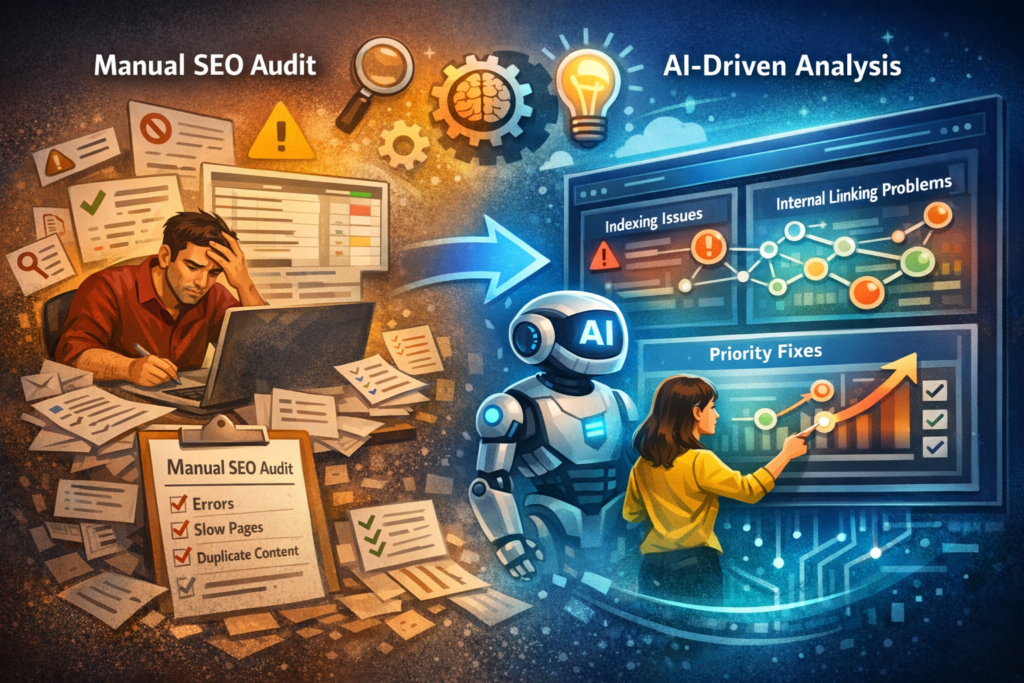
Technical audits tend to be more manual than not. Run your audit, download your results, and begin analyzing your data. This approach works, but it tends to leave something to be desired in terms of insight generation, particularly for larger sites and complex Technical SEO environments.
This is where AI comes into play and shifts the paradigm around data analysis.
Rather than going through your problems one page at a time, AI can find connections between various elements within your website. Perhaps a certain page type is failing because of poor internal linking. Alternatively, maybe there are multiple pages suffering from an indexing issue.
These types of connections tend to be lost on traditional audits.
The presentation of insights is another way in which things have changed.
Instead of having to go through a list of technical issues, AI can give you a better understanding of what’s happening and provide actionable solutions—something that modern AI SEO practices rely on heavily.
Certainly one of the most useful changes is that of prioritization. Not all problems need to be attended to right away, and AI can help you concentrate on those that affect your performance. Rather than wasting time on everything else, you can prioritize things that matter, making your Technical SEO audit far more effective.
Role of AI Tools in SEO Audits
AI is not an isolated concept but rather works best when used alongside the right SEO tools.
Most SEO audits start with a crawl from tools such as Screaming Frog and Sitebulb. These crawls aim to gather all kinds of information from the website—status code, redirections, metadata, etc. This serves as the base for every audit and supports a structured AI SEO workflow.
Where AI plays its role is in helping you make better sense of the collected data.
With help from platforms such as Surfer SEO and Alli AI, you can analyze this information and get recommendations accordingly, thus saving time and effort while strengthening your overall AI marketing strategy.
In addition to other types of functionality, flexible tools such as ChatGPT can be helpful for analyzing exported data, summarizing larger reports, generating schema markup and performing technical functions such as creating scripts and interpreting logs. By combining these SEO tools with each other, you gain additional value. You get the information using a crawler, and then you can apply that knowledge using AI. These two types of technologies together create a more efficient workflow than conventional processes and strengthen your AI SEO workflow.
A Practical Workflow: How AI Fits Into the Audit Process
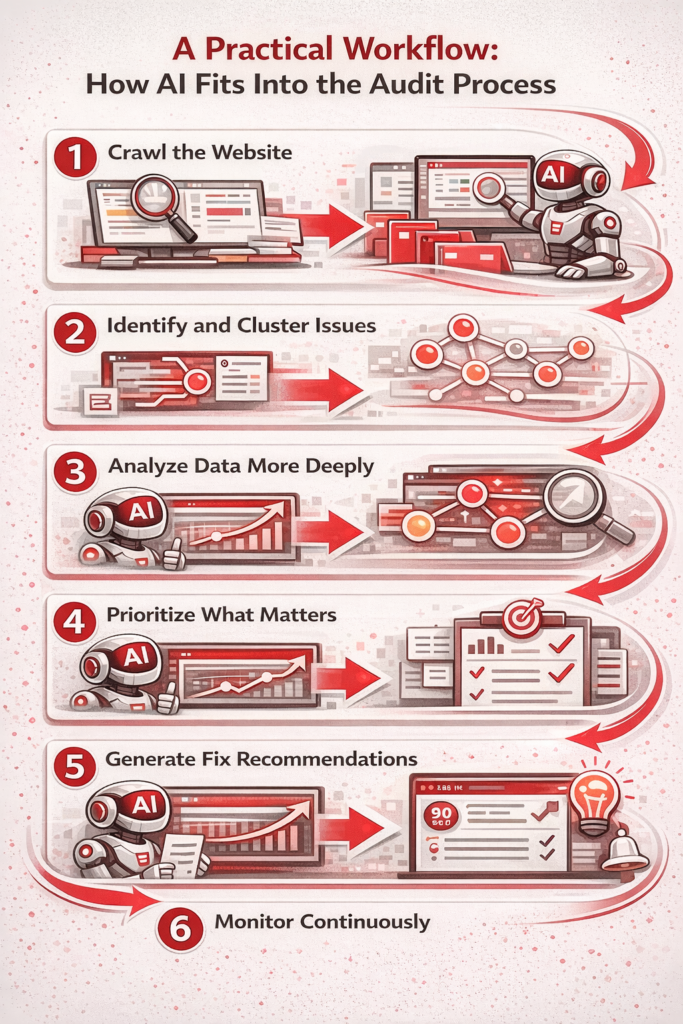
Despite integrating AI technology, the audit process will look the same. It would only become more productive in all aspects, especially when building a scalable AI SEO workflow.
Initially, the procedure starts with performing the full website crawl. It gives you a general idea about the current status of the website. The difference is in the following steps.
Firstly, instead of analyzing each problem, you could integrate AI into the process. By doing this, you would automatically filter the data into groups according to some common characteristics. Such an approach saves you time because you get an opportunity to evaluate the information from another perspective.
In addition, during the analysis process, you would switch to a higher level. That means that, besides solving specific issues, you would try to find out their reasons. Let’s say several pages are not indexed. You could use AI and see why it happened—an approach increasingly common in AI SEO practices.
After gaining clarity on your objectives, it makes prioritization easier. AI tools will be able to help you identify the problems that could cause the largest amount of damage to your website depending on parameters such as traffic, importance of pages, and website efficiency overall. This ensures your Technical SEO audit aligns with your broader marketing strategy for growth.
It will also make implementing changes simpler because AI will be able to provide you with recommendations regarding what changes should be made, from improving internal linking to writing structured data and implementing technical fixes. Although these recommendations will need to be reviewed before being implemented, the process will become much faster.
Lastly, you will be able to monitor your website’s condition through continuous auditing, rather than making audits an occasional task, supported by advanced SEO tools.
Where AI Still Needs Human Judgment?
Although AI has made tremendous progress within technical SEO audit software, it still cannot be trusted blindly. First and foremost, AI cannot entirely replace human expertise – it is most effective when used as a tool for making things easier for people.
In other words, AI is great at detecting problems and suggesting possible solutions, but it is not very good at taking into account contextual information. Therefore, AI may suggest certain changes solely based on statistics, neglecting other crucial factors such as business goals and practicality of implementation within your AI marketing strategy.
Over-optimisation is also a risk when you’re using AI-generated guidance. The suggestions could be too aggressive or too generic and provide an opportunity for you to create a change that’s not inline with the broader strategic direction of your overall plan. If the AI-generated recommendations aren’t closely reviewed, the result could be detrimental to your business.
Another major limitation of AI is that the AI platform can identify the problems with your website, but it still requires human assessment of the problem and whether or not it can be fixed within your overall Technical SEO framework.
Treat your AI as an intelligent, capable assistant to assist you with tasks. Allow the AI to do the hard work for you, but retain final authority on how to proceed on your strategy, when, and what actions to take. This balance of human and machine will result in a great audit being an extremely useful one.
Conclusion
The concept of a technical SEO audit will still be around, however the way we do them will continue to change.
Using Artificial Intelligence technology provides us with more efficient and clearer ways to handle SEO audits. It saves time by automating repetitive tasks, helps to find deeper insights and allows you to make decisions instead of relying solely on sorting through large amounts of data.
However, remember that AI is there to assist you – it’s not going to replace you. The best results come when automation is used alongside human experience and judgement.
As websites continue to grow in complexity and data grows exponentially, the balance between AI and human judgement will become increasingly important. Those companies that are able integrate AI into their workflow will save time and have greater clarity on the true drivers of SEO performance.
At the end of the day, that’s the purpose of every single SEO audit.


